

Claude Sonnet 5 Is Out: Why the Cost Story Disappoints
On this page
The Workhorse Is Better, But the Cost Story Is Messy
On June 30, 2026, Anthropic released Claude Sonnet 5. The short version is not "a new chatbot is out." The useful version is more uncomfortable: Sonnet 5 is a real upgrade over Sonnet 4.6, but the high-effort value story is weaker than the launch framing makes it sound.
Sonnet 5 is the new default model for Claude Free and Pro users, available to Max, Team, and Enterprise plans, live in Claude Code, and available through the Claude API as claude-sonnet-5. It ships with a 1M-token context window, 128k max output, and adaptive thinking. At launch, Anthropic described $2 per million input tokens and $10 per million output tokens as introductory pricing through August 31, 2026, with a move to $3 input and $15 output expected afterward.
Update — September 12, 2026: Anthropic has made the $2 input / $10 output price permanent. Those prices are per million tokens. The launch article originally described an August 31 end date and a move to $3 / $15; the present-tense comparisons below are corrected, while the original task-level cost argument remains.
Update — September 24, 2026: Claude Opus 5.5 (released September 22, 2026, at $4 input / $20 output per million tokens) replaced Opus 4.8 as Anthropic's recommended Opus model; Opus 4.8 is now a legacy model. Where this June 30 article says to keep Opus 4.8 as the escalation lane, read Opus 5.5, and re-run the task-level cost comparison, because the Opus list price is now lower than the $5 / $25 used below.
That pricing detail matters because the list price does not settle the buying decision. Sonnet 5 is cheaper per token than Opus 4.8, but high and xhigh effort can spend enough thinking and tool-use budget that the task-level cost starts to look uncomfortably close to Opus. Add the new tokenizer, which can produce about 30% more tokens for the same text, and our reaction is mixed: useful model, disappointing economics for demanding work.
Practice in AIErudit: if you want to turn this release into a repeatable workflow instead of a model-name debate, start with Claude 101, then build the routing and eval discipline in AI Delivery Systems and AI Evals, Observability and Red-Teaming.
What Sonnet 5 Does
Anthropic describes Sonnet 5 as its most agentic Sonnet model yet. In practical terms, that means it is meant to do more than answer a prompt:
- make and keep a plan across multiple steps
- call tools such as browsers, terminals, code execution, and computer-use interfaces
- continue through messy debugging or workflow chains where earlier Sonnet models stopped short
- check its own output more often without being explicitly asked
- run with adaptive thinking and tunable effort levels instead of a fixed manual thinking budget
- use the Sonnet price tier for work that used to push teams toward Opus
The launch is also an API and workflow change. The prompting guide for Sonnet 5 says existing Sonnet 4.6 prompts usually work well, but it also calls out behavior changes that product teams should test: more literal instruction following, more tool use, better progress updates, different verbosity, and a new tokenizer that can produce about 30% more tokens for the same text.
For an application team, that combination is the point. Sonnet 5 is not only smarter. It is a new operating default for cheaper autonomous work.
Where Sonnet 5 fits
Route by task value, not model prestige.
Start
New AI task enters the workflow
In parallel
- A
Short, cheap, latency-sensitive task -> Haiku or low effort Sonnet
- B
Coding, agents, computer use, professional work -> Sonnet 5
- C
Highest-accuracy long-horizon reasoning -> Opus 4.8 or Fable 5
- D
Restricted defensive cyber research -> Mythos program only
Then merge
Measure acceptance rate, cost, latency, retries, and safety refusals
Links (8)
- New AI task enters the workflow → Short, cheap, latency-sensitive task -> Haiku or low effort Sonnet, Coding, agents, computer use, professional work -> Sonnet 5, Highest-accuracy long-horizon reasoning -> Opus 4.8 or Fable 5, Restricted defensive cyber research -> Mythos program only
- Short, cheap, latency-sensitive task -> Haiku or low effort Sonnet → Measure acceptance rate, cost, latency, retries, and safety refusals
- Coding, agents, computer use, professional work -> Sonnet 5 → Measure acceptance rate, cost, latency, retries, and safety refusals
- Highest-accuracy long-horizon reasoning -> Opus 4.8 or Fable 5 → Measure acceptance rate, cost, latency, retries, and safety refusals
- Restricted defensive cyber research -> Mythos program only → Measure acceptance rate, cost, latency, retries, and safety refusals
Sonnet 5 is the default workhorse; Opus remains the escalation lane.
Why It Is Better Than Sonnet 4.6
The official Sonnet 5 system card is more useful than the headline because it separates capability, safety, and migration risk. The broad pattern is clear: Sonnet 5 improves over Sonnet 4.6 on coding, agentic search, multimodal reasoning, and professional-task performance.
| Evidence from Anthropic's launch/system-card materials | Sonnet 4.6 | Sonnet 5 | Product interpretation |
|---|---|---|---|
| SWE-bench Pro | 58.1 | 63.2 | Better hard software-engineering follow-through |
| Terminal-Bench 2.1 | 67.0 | 80.4 | Stronger terminal-agent execution |
| BrowseComp, single agent | 76.2 | 84.7 | Better difficult web search and synthesis |
| Humanity's Last Exam, with tools | 46.8 | 57.4 | Better tool-assisted reasoning |
| OSWorld-Verified | 78.5 | 81.2 | Incremental but useful computer-use gain |
| FrontierCode v1 | 15.1 | 38.8 | Much stronger on the newer coding-agent frontier test |
The safety story is not just "more refusals." In prompt-injection tests for coding environments, the system card reports Sonnet 5 attack-success rates around 0.31% with thinking and 0.29% without thinking, compared with Sonnet 4.6 rates of 12.71% and 45.26%. In browser-use environments, Sonnet 5 also performed far better than Sonnet 4.6 before safeguards, and no successful attacks were observed for Sonnet 5 after Anthropic's new browser-use safeguards were enabled.
That matters because agents are exposed to untrusted text all the time: web pages, GitHub issues, docs, tickets, emails, CSVs, and support threads. A model that is stronger at tool use but weak against prompt injection is a production risk. Sonnet 5 improves both sides of that equation: more autonomous execution, and stronger robustness in the agent settings Anthropic evaluated.
The caveat is equally important: these are still vendor-run evaluations. They are useful launch evidence, not a substitute for your own eval set.
Sonnet 5 vs Opus 4.8: The Disappointing Part
The honest answer is that Sonnet 5 narrows the gap with Opus 4.8, but the gap does not close in the direction we wanted. At low and medium effort, Sonnet 5 looks like a sensible Sonnet 4.6 replacement. At high and xhigh effort, Anthropic's own BrowseComp chart becomes a warning label.
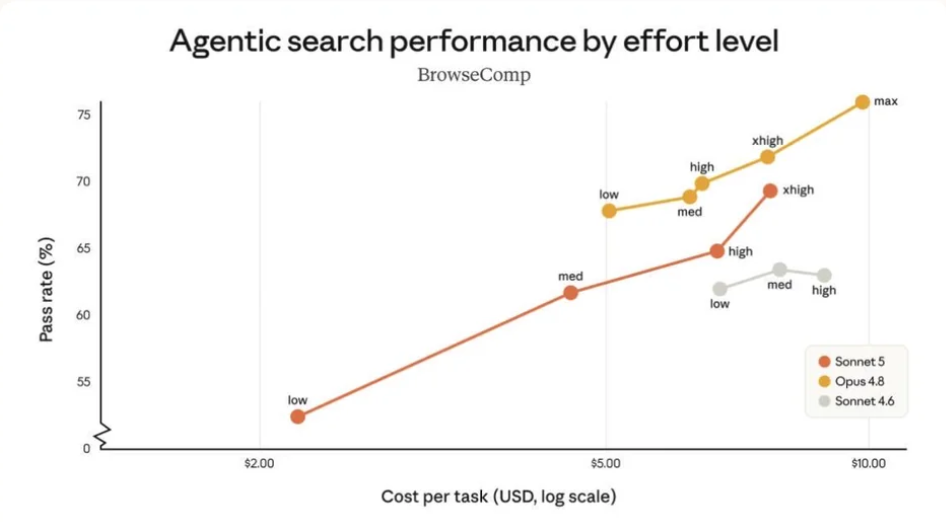
Figure: Anthropic's BrowseComp cost-performance chart from the Sonnet 5 launch discussion. The chart is for agentic search, not all coding or writing tasks, but it is still the clearest public task-level cost signal Anthropic published.
The uncomfortable read is simple: Sonnet 5 at high and xhigh can land in the same cost band as Opus 4.8 at low or medium, while Opus shows a higher pass rate on this benchmark. That is not just a benchmark footnote. It means a team could pay Sonnet-like token prices and still end up with Opus-like task bills once effort, retries, tool calls, and the new tokenizer are counted.
That is why the Reddit reaction resonated with us. The thread was blunt: for demanding work, why choose Sonnet 5 high-effort if Opus 4.8 low/medium can be cheaper per completed task and more capable on the published chart? We do not treat a Reddit thread as benchmark evidence, but we do treat it as useful buyer sentiment: practitioners immediately noticed that the "cheaper workhorse" story breaks down when you look at task-level cost instead of list price.
There are still real wins. Sonnet 5 is a clear upgrade over Sonnet 4.6, and the headline benchmark table still has strong news for teams that want a better everyday model. But the high-effort comparison should make product owners more conservative, not more excited.
| Question | Our read |
|---|---|
| Is Sonnet 5 better than Sonnet 4.6? | Yes. The official benchmark and system-card evidence point to a meaningful upgrade. |
| Is Sonnet 5 cheaper than Opus 4.8 per token? | Yes. Standard Sonnet 5 pricing is $2 input / $10 output per million tokens, versus $5 / $25 for Opus 4.8. |
| Is Sonnet 5 high-effort always cheaper per completed task? | No. The BrowseComp chart suggests high and xhigh effort can move Sonnet 5 into Opus-like task-cost territory. |
| Does the tokenizer matter? | Yes. Claude docs say the same text can produce about 30% more tokens than Sonnet 4.6, so "same per-token price" is not the same as "same job price." |
| Should Opus 4.8 stay in the routing plan? | Absolutely. For high-stakes agentic search, deep coding, architecture, review, and rescue passes, Opus 4.8 remains the escalation lane. |
Put the broader published numbers side by side and the picture stays nuanced: Opus 4.8 leads on the hardest agentic coding, the two are a near tie on tool-assisted reasoning, and Sonnet 5 edges Opus on one broad knowledge-work score. That does not rescue the high-effort value story; it just tells us not to flatten the decision into one benchmark.
| Benchmark | Sonnet 4.6 | Sonnet 5 | Opus 4.8 | Read |
|---|---|---|---|---|
| SWE-bench Pro (agentic coding) | 58.1 | 63.2 | 69.2 | Opus still wins the hardest software engineering |
| Humanity's Last Exam, with tools | 46.8 | 57.4 | 57.9 | Effectively tied; the 0.5 point gap is noise |
| GDPval-AA v2 (real knowledge work) | n/a | 1,618 | 1,615 | Sonnet 5 narrowly beats Opus 4.8 here |
| Price (input / output, standard) | $3 / $15 | $2 / $10 | $5 / $25 | List price favors Sonnet; task-level cost can still favor Opus |
Sonnet 4.6 and Sonnet 5 values are from Anthropic's launch and system-card materials; the Sonnet 5 vs Opus 4.8 deltas are reported consistently by The Decoder and MarkTechPost. "n/a" means no comparable published figure.
Sonnet 5 is not a blanket Opus replacement
Low and medium effort look useful; high effort needs proof before it becomes policy.
Sonnet 4.6 (4 points)
- •
Prior Sonnet workhorse
- •
Cheaper than Opus per token
- •
Weaker agentic follow-through
- •
Replace where Sonnet 5 passes evals
Sonnet 5 (4 points)
- •
Better Sonnet, not free Opus
- •
High effort can get expensive
- •
Tokenizer raises equivalent job cost
- •
Best for measured low/medium bulk work
Opus 4.8 (4 points)
- •
Higher pass rate on BrowseComp curve
- •
Still leads hard coding
- •
Better escalation for important tasks
- •
Worth testing at low/medium first
Default: Sonnet 5 for measured low/medium work; Opus 4.8 for important high-effort jobs.
So the buying decision should not be "Sonnet or Opus?" It should be:
| Workload | Start with | Escalate when |
|---|---|---|
| Routine coding edits, test fixes, documentation updates | Sonnet 5 at low or medium effort |
Acceptance rate drops or the model misses subtle repo constraints |
| Medium-effort bulk work and subagents | Sonnet 5 at medium effort |
Retry rate erases the list-price advantage |
| Multi-file feature implementation | Opus 4.8 at low or medium first for planning/review; Sonnet 5 only where evals prove it wins |
The task needs deep architecture judgment or repeated recovery from failed plans |
| Long autonomous coding sessions | Mixed routing: Sonnet 5 for cheap steps, Opus 4.8 for hard planning, review, and rescue | Sonnet high/xhigh approaches Opus task cost without matching pass rate |
| Agentic search and browser workflows | Benchmark Sonnet 5 and Opus 4.8 side by side | The task needs maximum accuracy, or BrowseComp-like failure modes matter |
| Sensitive cyber capability work | Neither as a casual default | Follow Anthropic's restricted access and safety guidance |
I found early public partner signals, including Anthropic's quoted partner examples and AWS's launch guidance, but not a rigorous independent Sonnet 5 vs Opus 4.8 field teardown with reproducible task traces on launch day. Treat any single-day "I tested it and it wins" post as a lead, not a routing policy.
For Sonnet 5 vs Sonnet 4.6, the public evidence is stronger. Anthropic publishes direct benchmark comparisons, the system card gives safety and capability deltas, and early partner anecdotes describe the same pattern: Sonnet 5 finishes more multi-step work without stopping halfway.
How Sonnet 5 Compares With OpenAI and Google
Anthropic did not publish an official Sonnet 5 head-to-head against OpenAI's GPT-5.5 or Google's Gemini 3.5 line, and GPT-5.6 had not launched as of the June 30 release. So the cross-vendor picture comes from independent coverage running the same public benchmarks, not from a vendor scoreboard. Treat it as directional.
| Benchmark | Claude Sonnet 5 | OpenAI GPT-5.5 | Google Gemini 3.5 Flash |
|---|---|---|---|
| SWE-bench Pro (agentic coding) | 63.2 | 58.6 | 55.1 |
| Terminal-Bench 2.1 (terminal agent) | 80.4 | 83.4 | not published |
Cross-vendor figures from CodersEra's launch guide and corroborated in MarkTechPost's comparison. Benchmark harnesses differ between labs; only your own eval set settles a routing decision.
The honest read: Sonnet 5 takes the agentic-coding benchmark (SWE-bench Pro) over GPT-5.5 and Gemini 3.5 Flash, while GPT-5.5 edges it on raw terminal-agent execution. These are close enough that price, ecosystem, data-residency, and safety posture should drive the choice as much as the leaderboard. On price, MarkTechPost notes Gemini 3.5 Flash and Gemini 3.1 Pro undercut Sonnet 5 per token, so for high-volume, low-stakes throughput a Gemini Flash tier can still win on cost — the same "route by task value" logic applies across vendors, not just inside Anthropic's own ladder.
The Migration Notes Developers Should Not Skip
If you use Claude only through the web app, you can mostly start trying Sonnet 5 immediately. If you maintain an API integration, do a small migration pass before routing production traffic.
| Change | What to do |
|---|---|
| Model ID | Use claude-sonnet-5; current Claude IDs from the 4.6 generation onward are pinned snapshots even without a date suffix |
| Adaptive thinking | Requests without a thinking field now run with adaptive thinking on Sonnet 5 |
| Manual thinking budgets | Remove thinking: {"type": "enabled", "budget_tokens": N}; Sonnet 5 rejects manual extended thinking budgets |
| Effort | Use output_config with effort set to medium, high, xhigh, or max to tune cost and depth |
| Sampling params | Remove non-default temperature, top_p, and top_k; Sonnet 5 rejects them |
| Token limits | Recheck max_tokens; the new tokenizer may produce about 30% more tokens for the same text |
| Code-review prompts | If recall appears lower, check whether the model is following "only high severity" instructions more literally |
The best migration test is small and boring: replay 30 to 50 real prompts from your current Sonnet 4.6 production lane, compare accepted-output rate, cost, latency, retry rate, tool-call correctness, and failure modes, then decide which effort level becomes your default.
Where Sonnet 5 Looks Especially Strong
Sonnet 5 is probably best for teams that have already moved beyond chat and into workflows.
Use it for coding agents that need to read a codebase, write a reproducing test, make a patch, run checks, and revise. Use it for browser or desktop automation where the model must stay on plan while interacting with changing screens. Use it for knowledge-work agents that turn long messy inputs into briefs, audits, research packs, and decision memos. Use it for code-review harnesses where precision, tool use, and self-verification matter.
It is also attractive for product owners because it changes the economics of agentic pilots. If Sonnet 5 handles a workflow that previously needed Opus, a pilot can move from "impressive but expensive" to "cheap enough to run repeatedly." That is where real adoption starts: not when the demo works once, but when the workflow can be measured every day.
The risk is the same one we teach in AI Agentic Patterns: stronger autonomy makes weak process more visible. A better model will still fail if the task has no acceptance criteria, no data boundary, no eval set, and no fallback route.
A Product Owner's Evaluation Checklist
Before switching defaults, run this checklist.
- Pick five workflow families: coding edit, code review, research, browser/computer use, and professional writing.
- For each family, replay real tasks against Sonnet 4.6, Sonnet 5, and Opus 4.8 where cost allows.
- Test
medium,high, andxhigheffort for Sonnet 5 before assuming the default is best. - Track accepted output, human edit time, retries, truncation, tool-call errors, safety refusals, and total cost per accepted task.
- Include prompt-injection fixtures for agent workflows that ingest web pages, issues, tickets, emails, or third-party docs.
- Keep Opus 4.8 as an escalation lane until Sonnet 5 proves it can handle your hardest cases.
- Recheck Anthropic's current pricing before procurement, then revisit the routing decision with your latest accepted-task cost data.
The Take
Sonnet 5 is a bigger release than a simple model refresh because it makes the Sonnet lane more capable. But we are disappointed by the high-effort economics. The promise was easy to hear as "near-Opus work at Sonnet cost." The BrowseComp chart says something less comfortable: at higher effort, Sonnet 5 can approach or exceed Opus 4.8 low/medium task cost while still trailing the Opus pass rate.
That does not make Sonnet 5 a bad model. It makes it a model that needs routing discipline.
Use it where it is clearly better than Sonnet 4.6: low/medium effort coding support, subagents, review prep, knowledge-work drafts, browser steps, and workflows where speed or volume matter. Keep Opus 4.8 for important jobs until your own evals prove that Sonnet 5 produces a lower cost per accepted result.
The right response is not to rewrite every prompt tonight. The right response is to measure accepted output, retries, latency, and total task cost, then move only the workflows that actually win.
Source notes: the Sonnet 5 vs Opus 4.8 deltas above come from MarkTechPost's launch comparison; the GPT-5.5 and Gemini 3.5 Flash cross-vendor numbers come from CodersEra's launch guide; the Reddit r/ClaudeAI thread is community reaction used as buyer-sentiment input, not as primary benchmark evidence. All links are in the source list below.
Original analysis source-checked June 30, 2026. Pricing correction source-checked September 12, 2026 against Anthropic's current Sonnet 5 model documentation. Pricing, availability, and partner benchmark pages should still be rechecked before procurement or production default changes.
Continue learning with these courses
Sources and Further Reading
- Anthropic: Introducing Claude Sonnet 5anthropic.com
- Anthropic: Claude Sonnet 5 System Cardanthropic.com
- Anthropic: Claude Sonnet product pageanthropic.com
- Claude Platform Docs: What's new in Claude Sonnet 5platform.claude.com
- Claude Platform Docs: models overviewplatform.claude.com
- Claude Platform Docs: pricingplatform.claude.com
- Claude Platform Docs: model IDs and versioningplatform.claude.com
- Claude Platform Docs: upgrade between model versionsplatform.claude.com
- Claude Platform Docs: prompting Claude Sonnet 5platform.claude.com
- Claude Platform Docs: effortplatform.claude.com
- Claude Platform Docs: adaptive thinkingplatform.claude.com
- AWS: Introducing Claude Sonnet 5 on AWSaws.amazon.com
- Amazon Bedrock: model-region compatibilitydocs.aws.amazon.com
- Microsoft Foundry: Claude Sonnet 5 generally availabletechcommunity.microsoft.com
- Claude Platform Docs: Claude in Microsoft Foundryplatform.claude.com
- OpenRouter: Claude Sonnet 5 provider pageopenrouter.ai
- Claude Platform Docs: What's new in Claude Opus 4.8platform.claude.com
- Anthropic: Introducing Claude Sonnet 4.6anthropic.com
- Anthropic: Introducing Claude Sonnet 4.5anthropic.com
- Anthropic: Dynamic workflows in Claude Codeclaude.com
- TechCrunch: Anthropic launches Claude Sonnet 5 as a cheaper way to run agentstechcrunch.com
- Simon Willison: Claude Opus 4.8simonwillison.net
- Jake Handy: Model Drop Claude Sonnet 5handyai.substack.com
- SWE-benchswebench.com
- Terminal-Benchtbench.ai
- BrowseCompopenai.com
- OSWorld-Verifiedxlang.ai
- CursorBenchcursor.com
- The Decoder: Claude Sonnet 5 closes the gap to Opusthe-decoder.com
- MarkTechPost: Sonnet 5 vs Sonnet 4.6 vs Opus 4.8marktechpost.com
- CodersEra: Claude Sonnet 5 launch guide (cross-vendor benchmarks)codersera.com
- VentureBeat: Anthropic launches Claude Sonnet 5 at a steep discountventurebeat.com
- Reddit r/ClaudeAI: Sonnet 5 vs Opus 4.8 high/xhigh discussionreddit.com
Stay ahead with AI insights
Get practical AI tips, new course announcements, and career strategies delivered weekly.
Stay ahead with AI insights
The signup form opens as soon as this page finishes loading. If it does not appear — for example if JavaScript is unavailable — email us and we will subscribe you.