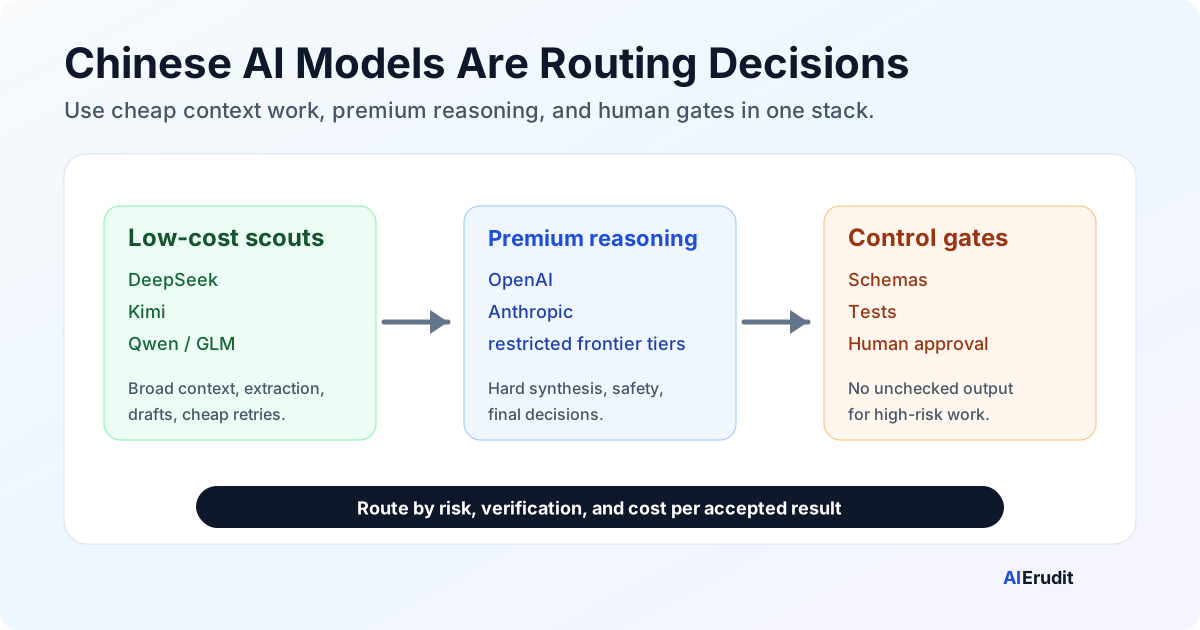
Chinese AI Models Are Now Routing Decisions
On this page
Update — September 24, 2026: This routing analysis was written on June 29, 2026, and the closed-frontier lineup it uses as the premium reference has since moved. GPT-5.5, Claude Opus 4.8 and Claude Fable 5 are now previous-generation models: OpenAI's docs call GPT-6 Astra its most capable model (with GPT-6 Sol and GPT-6 Luna below it), and Anthropic's current lineup is Fable 5.1, Opus 5.5, Sonnet 5 and Haiku 4.5. The prices and index scores below describe June 2026, not today; the routing method still applies. Re-check each vendor's pricing page before you reuse a number.
The replacement question is too small
The noisy version of the debate is simple: can DeepSeek, Kimi, GLM, Qwen, or MiniMax beat OpenAI and Anthropic?
The useful version is harder: which parts of your AI system should you route to low-cost Chinese or open-weight models, and which parts still deserve a premium closed frontier model?
That distinction matters because Chinese models have moved from "interesting cheap alternatives" to credible workflow components. DeepSeek made sparse reasoning models feel commercially serious. Moonshot AI's Kimi line turned a once-obscure startup into a direct agentic-coding comparison point against premium Claude and GPT tiers. Z.ai, Qwen, and MiniMax widened the field with strong coding, long-context, and open-weight releases.
But routing is not the same as blind replacement. A model can be cheap, fast, and strong on public benchmarks while still being the wrong choice for regulated data, final legal review, high-stakes security decisions, or a customer-facing answer that needs the newest safety and enterprise controls.
Practice in AIErudit: start with AI Delivery Systems if you want to build model-routing and fallback logic, then pair it with AI Token Economics and Budget Operations to measure cost per accepted result instead of cost per raw token.
Meet the 2026 Chinese model stack
The Chinese model story is not one model. It is a stack, and in 2026 it moves fast enough that last year's reference points are already stale.
DeepSeek made the economics visible. Its V3 and R1 work showed how sparse mixture-of-experts models and reinforcement-learning-heavy reasoning training could produce competitive capability without copying the exact cost structure of the largest U.S. labs. By mid-2026 the relevant DeepSeek models are no longer V3 and R1 (both scheduled for retirement) but the V4 line: a large mixture-of-experts V4-Pro with a 1M-token context and a smaller, very cheap V4-Flash. DeepSeek publishes API prices that still make many teams re-run their budget math.
Moonshot AI's Kimi line changed the coding-agent conversation. The base Kimi K2 is a trillion-parameter MoE designed for agentic intelligence; the later K2.5 (multimodal) and K2.6 (marketed around coding and agent swarms) are open-weight and explicitly aimed at repository work, tool use, and long-horizon execution. Those are vendor claims, so they are not neutral proof. They matter because they show where Chinese labs want the comparison to happen: not chat, but code-agent loops.
Z.ai, Qwen, and MiniMax fill in the ecosystem. Z.ai describes its GLM-5.2 as a ~753B mixture-of-experts model with a 1M-token context under an MIT license. Alibaba's Qwen3-Coder and its successors target code agents and tool use. MiniMax pushes long-context, efficient reasoning (MiniMax-M1 and the later M3 release). Together they make "Chinese model" a category that now spans cheap direct APIs, open-weight self-hosting, marketplace routing, and paid product wrappers.
That is why the replacement question is too small. The stronger claim is: Chinese models are now routing decisions.
How far behind are Chinese models now?
There are three honest answers, depending on what you measure — and the gap is a moving target, not a wall.
First, the headline gap has compressed sharply. Stanford HAI's 2026 AI Index reports that U.S. and Chinese models have traded the lead several times since early 2025, and that by March 2026 the best U.S. model led the best Chinese model by roughly 2.7% on its aggregate measure. A year earlier, DeepSeek-R1 had already briefly matched the top U.S. model. The weaker Chinese models are simply no longer the right reference point.
Second, the lag is measured in months, not generations — with caveats. Epoch AI's U.S.-vs-China analysis (January 2026) puts the average lag at about 7 months, ranging from 4 months at the closest to 14 months at the widest, and notes that as of that snapshot no Chinese model had yet surpassed the capability index of OpenAI's o3 (an April 2025 reasoning model — a demanding bar, though no longer the absolute frontier). A separate Epoch view finds open-weight models trail the closed frontier by about 4 months. "Months, not a generation" is fair — as long as you remember that a 14-month tail still exists and the newest closed tier can reopen it overnight.
Third, "gap" is not one number. Coding, math, extraction, multimodal reasoning, long-context retrieval, refusal behavior, latency, and enterprise controls all move at different speeds. On real-issue coding (SWE-bench Verified snapshots, mid-2026), the best Chinese open models land in the high-70s to low-80s percent, while the top U.S. closed tier sits in the high-80s to mid-90s — a real lead, but a much narrower one than the brand-name gap of two years ago.
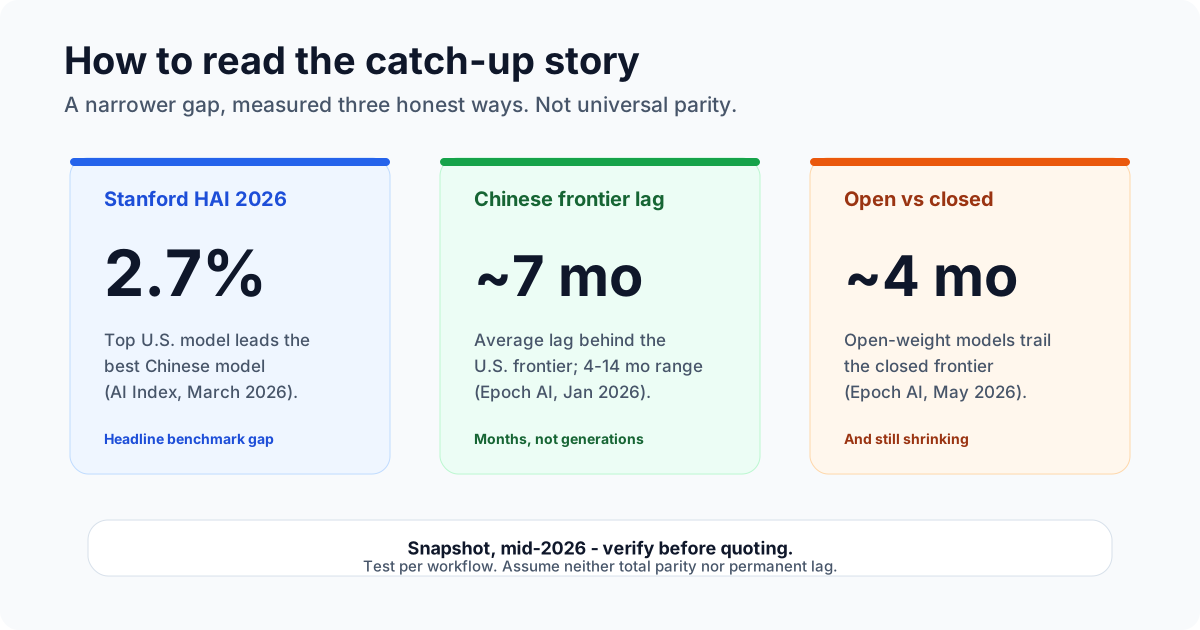
The chart is intentionally conservative. It does not say Chinese models have "caught up" everywhere. It says the lag has become narrow enough that buyers should test task-by-task instead of assuming the answer from a brand name.
The scoreboard: capability, price, and openness in one view
Here is a like-for-like snapshot of the models this article keeps mentioning. Treat every number as a dated reading, not a contract — leaderboards and price pages move weekly, which is exactly why you re-check before you buy.
| Model | Origin | Open weights | Input $/M | Output $/M | Intelligence Index* | Typical role |
|---|---|---|---|---|---|---|
| DeepSeek V4-Flash | DeepSeek (CN) | Yes | $0.14 | $0.28 | — | High-volume scouting, extraction |
| DeepSeek V4-Pro | DeepSeek (CN) | Yes | $0.44 | $0.87 | 44 | Cheap reasoning, repo work |
| MiniMax M3 | MiniMax (CN) | Yes | $0.30 | $1.20 | 44 | Long-context, efficient reasoning |
| Kimi K2.6 | Moonshot AI (CN) | Yes | — | — | — | Agentic coding, agent swarms |
| GLM-5.2 | Z.ai / Zhipu (CN) | Yes (MIT) | $1.40 | $4.40 | 51 | Coding + reasoning generalist |
| GPT-5.5 | OpenAI (US) | No | $5.00 | $30.00 | 55 | Premium reasoning, product depth |
| Claude Opus 4.8 | Anthropic (US) | No | $5.00 | $25.00 | 56 | Frontier coding + agentic work |
| Claude Fable 5 | Anthropic (US) | No | $10.00 | $50.00 | 60 | Hardest reasoning; access-restricted |
*Intelligence Index = the aggregate score published by the independent Artificial Analysis dashboard at the time of writing. A dash means the figure was not published for that model at snapshot time — verify on the vendor or benchmark page before relying on it.
Two patterns jump out. The capability column is compressed — the best Chinese open model (GLM-5.2, 51) is within striking distance of the premium U.S. tier (55-60). The price column is not compressed at all. Even the closest-capability open model, GLM-5.2, already costs roughly 7x less than GPT-5.5 on output tokens; step down a few index points to the DeepSeek V4 or MiniMax tier and the multiple widens to 20x-35x. (You will see "50-100x cheaper" online; that compares a bargain-tier Chinese model against peak legacy GPT-4 pricing and is more headline than guidance.) Plot capability against price and the routing logic becomes almost embarrassingly obvious:
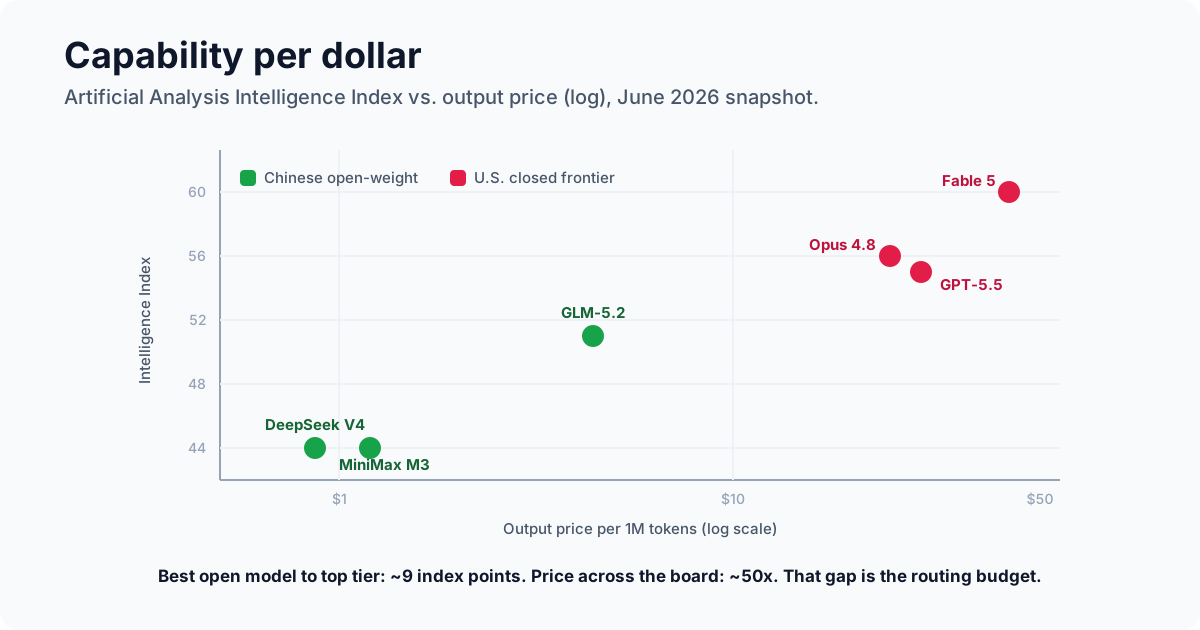
The cheapest model on the public dashboards — a small Qwen variant — runs around a cent per million tokens. That is less than the electricity you will burn re-reading its output to check it, which is the entire point: cheap models are for work you were going to verify anyway.
The new model pattern: sparse, long-context, agentic
The current Chinese wave has a recognizable pattern:
| Pattern | Why it matters | Examples to watch |
|---|---|---|
| Sparse MoE | Large total capacity with few active parameters per token can cut inference cost. | DeepSeek V4 family, Kimi K2 family, GLM-5.2 |
| Reasoning specialization | RL and reasoning traces improve math, coding, and multi-step problem solving, but can add latency. | DeepSeek reasoning line, MiniMax M-series, Qwen reasoning modes |
| Code-agent tuning | The benchmark target moves from chat answers to repository edits, tool use, browser tasks, and test repair. | Kimi K2.5/K2.6, Qwen3-Coder, GLM coding releases |
| Long context | Useful for codebase scanning, contract review, logs, and data extraction — but long context still needs retrieval discipline. | DeepSeek V4-Pro, GLM-5.2, MiniMax, Qwen (1M-token tiers) |
| Open or quasi-open weights | Enables self-hosting, fine-tuning, and private deployment when licensing and infra allow it. | Qwen (Apache), GLM-5.2 (MIT), MiniMax, DeepSeek, Kimi releases |
This is not only a China story. It is the dominant open-model playbook: make the model cheap enough to use in high volume, capable enough to win focused benchmarks, and accessible enough to become a component inside other products.
Why premium closed models still matter
If Chinese models are so cheap and increasingly capable, why pay for OpenAI or Anthropic?
Because the expensive model is often buying more than raw benchmark points. It may buy:
- more stable tool use in complex agent loops;
- better refusal behavior and safety documentation;
- enterprise data handling, support, and compliance controls;
- stronger multimodal and product integration;
- better final synthesis after many cheap workers have gathered evidence;
- a cleaner audit trail for regulated or board-level decisions.
Anthropic's Claude Opus 4.8 is a useful premium reference point because it is positioned around frontier coding and agentic performance, not just chat. Above it, Claude Fable 5 and Mythos 5 are a different kind of reference: Fable 5 shipped as Anthropic's most capable model, but Mythos 5 is reachable only through a restricted program, and access to both has been subject to availability and export-control pressure. A model whose access can be suspended is not a normal commodity dependency — a point AIErudit has covered in the Mythos/Fable access tax. On June 29, 2026, OpenAI's flagship was GPT-5.5 and "Sol" was a preview codename for an unreleased GPT-5.6 tier, not a model you could buy. OpenAI has since released GPT-6 Astra, Sol and Luna (see the September 24 update above); we unpack that hype cycle in the Sol rumor trap.
The buyer rule is simple: future or restricted premium model names are not a migration plan. They are scenario inputs. Do not redesign a production stack around a model until you can cite the official model docs, pricing page, safety note, and current availability state.
The token market is three markets at once
When people say "Chinese models are cheaper," they often blur three separate markets.
The first is direct API access. DeepSeek, Kimi, Z.ai, Alibaba/Qwen, and others publish endpoints and prices, frequently in OpenAI-compatible shapes because compatibility lowers switching cost.
The second is inference marketplaces. OpenRouter and similar platforms put many models behind one account and one API. This is where the adoption signal gets loud: by mid-2026, Chinese-origin models account for roughly 46% of all OpenRouter token volume, and DeepSeek alone — around 16% of tokens — pulls more traffic than Google and OpenAI combined on that platform (OpenRouter rankings). Marketplace share is not global market share — but it is a strong tell about what developers reach for when the cost meter is running.
The third is product wrapping. A coding product, support tool, or data agent can route to a Chinese base model behind a paid subscription. The customer may be paying for the workflow, editor integration, memory, tests, UI, and support; the underlying model is only one component. When the AI coding tool Cursor shipped its Composer 2 model, reporting established it was built on Moonshot's Kimi K2.5 base — a good example of why buyers should ask what model is actually behind a paid feature.
That is not automatically bad. A paid wrapper can be valuable if it adds a better harness, evals, security controls, and UX. The risk is opaque provenance: if your vendor will not tell you which model family, region, retention policy, and fallback path handles your data, you cannot make a serious governance decision — and you may be paying frontier prices for a model you could rent for the cost of a coffee, per million tokens.
Price bands make routing obvious
Raw prices change, discounts matter, and cache behavior can dominate real spend. Still, the published prices make one pattern obvious: it is wasteful to send every low-risk token to the most expensive frontier model.
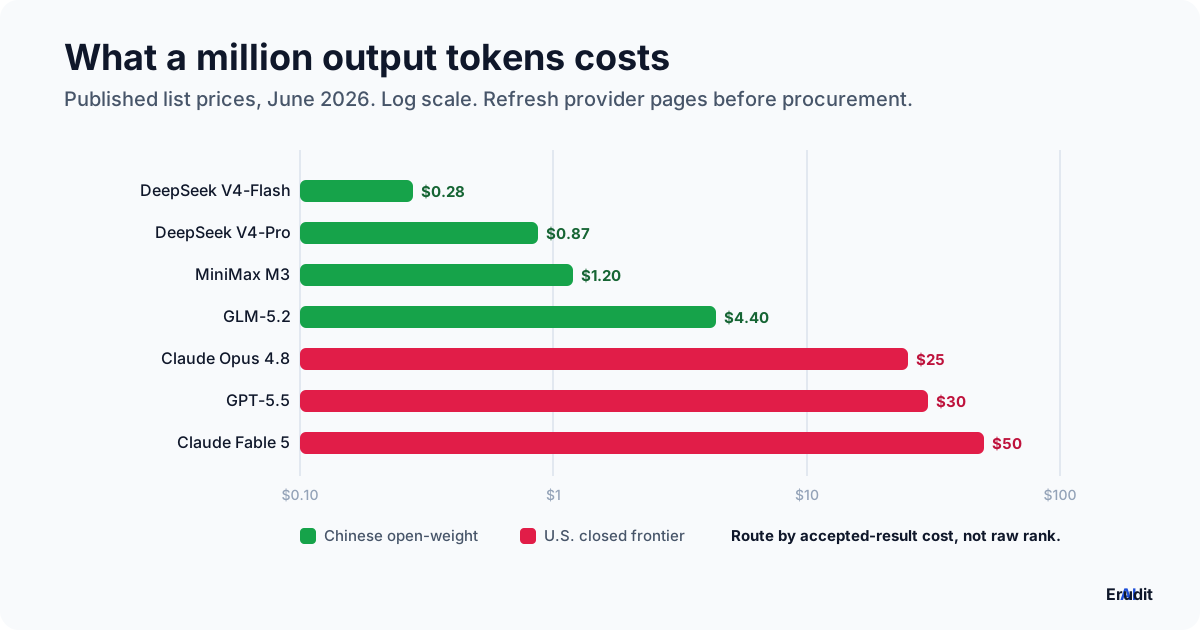
Use the price chart as a routing prompt, not as procurement advice. Before publishing or buying, refresh the provider pages. Then compute cost per accepted result:
| Workload | Cheap Chinese/open model role | Premium model role | What to measure |
|---|---|---|---|
| Repository scan | Map files, summarize modules, find likely owners, extract TODOs and contracts. | Decide risky refactors, architecture, and final patch strategy. | Correct files found per dollar; false negatives. |
| Data extraction | Parse invoices, logs, survey answers, call notes, or scraped pages into structured records. | Resolve ambiguous edge cases and policy-sensitive outputs. | Valid rows per dollar; manual correction rate. |
| Test generation | Draft fixtures, edge cases, and a regression matrix from existing specs. | Approve invariants and high-risk behavioral tests. | Useful tests kept; flaky tests rejected. |
| Customer support triage | Classify intent, summarize history, propose draft response. | Final answer for escalations, regulated content, or angry VIP customers. | Escalation accuracy; bad-send prevention. |
| Research synthesis | Cluster sources, extract dates, build comparison tables. | Final claim review and executive narrative. | Source coverage; unsupported claims caught. |
The cheap model is not "less important." It is the part of the system that can touch millions of reversible tokens. The premium model is the part that should touch fewer, harder, more consequential decisions.
A practical multi-agent routing stack
The best near-term architecture is a mixed model stack:
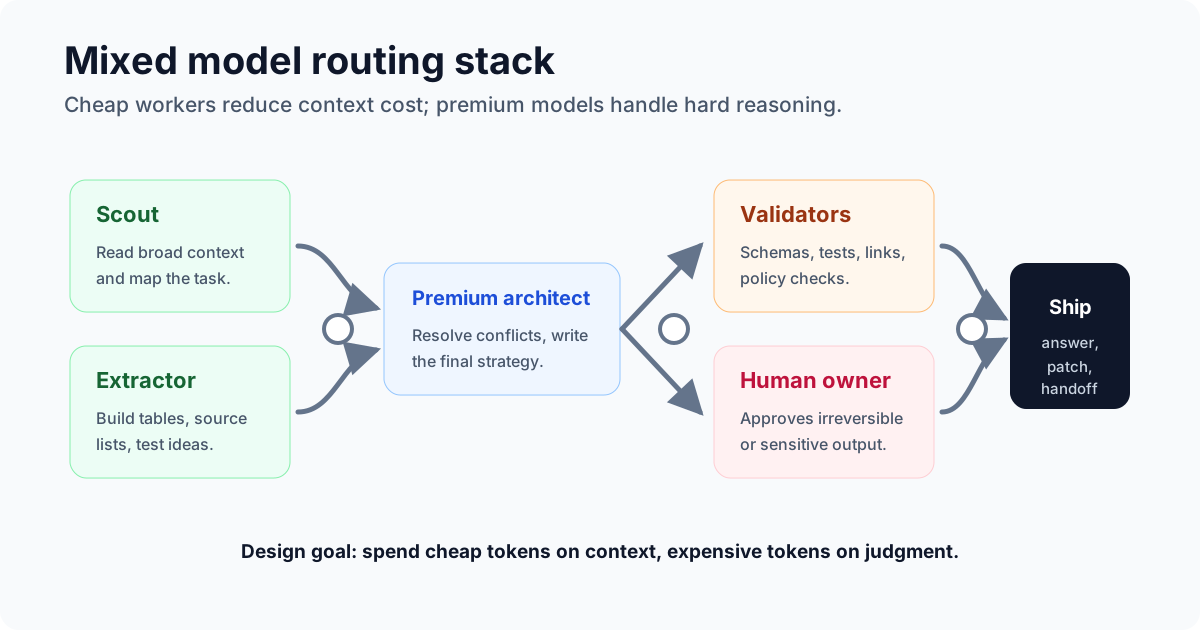
Text fallback:
- A cheap scout model reads broad context and produces a structured brief.
- A second cheap worker extracts tables, citations, code locations, or test candidates.
- A premium model checks the plan, handles hard reasoning, and writes the final synthesis.
- Deterministic validators check schemas, tests, links, and policy gates.
- A human owner approves irreversible actions.
This is where Chinese models can be especially valuable. They can read large repositories, parse noisy documents, and prepare structured evidence at low cost. That means the expensive model receives a smaller, cleaner problem.
Route cheap context work before premium judgment
Use lower-cost models when errors are detectable, then escalate only the consequential branch.
Decision tree (6 nodes)
- Start
Risky or irreversible?
Decision
Yes
Premium + human
Outcome
Broad
Scout model
Decision
Hard
Premium architect
Outcome
Extract
Validator gate
Outcome
Narrow
Cheap/script
Outcome
Route by reversibility, detectability, and data policy before you route by leaderboard rank.
Where Chinese models are economically attractive
Use Chinese models when four conditions are true:
- the task is high-volume;
- errors are detectable;
- the output is reversible;
- the data policy is acceptable.
Good candidates:
- codebase reconnaissance before a human or premium model edits code;
- log parsing, ticket clustering, and incident timeline drafts;
- spreadsheet normalization and structured extraction;
- translation, localization QA, and tone variants;
- first-pass documentation cleanup;
- test idea generation from already trusted specs;
- source clustering for research briefs;
- synthetic data generation when policy allows it;
- low-risk chat routing and FAQ draft generation;
- agent swarms where each worker has a narrow role and a validator.
Avoid or heavily constrain them when:
- the data cannot leave a specific region or vendor boundary;
- the vendor's retention policy is unclear;
- the model would make final legal, medical, financial, hiring, or security decisions;
- the task needs the newest premium multimodal or tool features;
- the output cannot be automatically checked;
- the customer expects a named OpenAI or Anthropic model in the contract;
- you cannot log the actual model ID used by a wrapper product.
Are Chinese models gradually catching up?
Yes, but not as a straight line.
They are catching up in published benchmark visibility, cost-performance, open availability, code-agent tasks, and high-volume automation — and the developer vote is already in, given how much marketplace traffic they pull. They are not uniformly caught up in enterprise trust, safety documentation, support, and the hardest frontier workloads. They can leap forward when a new architecture or training recipe lands, then lag again when a closed lab releases the next premium model.
That is why "they are behind by X months" is useful only as a market-level signal. For your own system, build a model scorecard:
| Scorecard dimension | Why it matters |
|---|---|
| Task success | Does it solve your actual task, not only a benchmark task? |
| Cost per accepted result | How many retries, validations, and human corrections does it need? |
| Latency | Can the workflow tolerate reasoning delay? |
| Tool reliability | Does it call tools correctly and recover from failures? |
| Context handling | Does it use long context or get lost inside it? |
| Safety and policy | Does it refuse correctly and respect your data boundary? |
| Observability | Can you log prompts, model IDs, outputs, retries, and validators? |
| Exit path | Can you switch models without rewriting the whole product? |
The model that wins your scorecard may be Chinese for one task and Anthropic or OpenAI for the next. (For a deeper version of this habit, see model selection without leaderboard brain.)
What if a restored Fable tier or OpenAI's "Sol" raises the bar?
Treat the next premium jump as a scenario, not a fact pattern. When this was written on June 29, 2026, the jump in question was OpenAI shipping the GPT-5.6 tier teased as "Sol," or Anthropic restoring and extending Fable/Mythos access; both have since moved (GPT-6 Sol and Claude Fable 5.1 — see the September 24 update above). The mechanism is the lasting point: whenever a premium tier moves, the frontier gap can reopen at the top end for the hardest tool use, code repair, long reasoning, and safety-sensitive work.
That does not make DeepSeek or Kimi irrelevant. It changes their job.
If the premium model is too expensive — or too restricted — for every token, the cheaper Chinese models become even more useful as scouts, extractors, graders, and parallel workers. They help reserve the premium model for the final 5-20% of the workflow: the part where higher reliability actually changes the outcome.
Could DeepSeek or another Chinese lab reach those premium metrics later? On public benchmarks, probably yes in several domains — the 2.7% headline gap and 7-month lag are not unbridgeable. On production reliability, enterprise governance, and restricted safety posture, the answer depends on capital, compute access, talent, distribution, and regulatory constraints. If DeepSeek or a peer raises outside capital, the strategic reason would not only be "train a bigger model." It would be to buy inference capacity, product support, global distribution, and enough evaluation machinery to compete with companies that spend heavily on the whole deployment system — not just the weights. That is an inference about strategy, not a confirmed financing fact; specific funding figures remain media-reported unless a primary source says otherwise. The confirmed lesson is narrower: model quality is only one part of frontier competition. Serving, support, safety, evals, and distribution are part of the model product.
Distillation claims need evidence
When a Chinese model appears close to a closed model, people often jump to distillation. Distillation is real: one model can be trained to imitate another model's outputs. It can be legitimate when the data rights are clear. It can also violate terms or create safety concerns when a closed model is harvested at scale.
But "the model is good" is not proof of distillation. Timeline coincidence is not proof. Similar benchmark behavior is not proof. A serious public claim needs technical evidence, legal evidence, or a provider statement.
The safer wording is:
- Chinese models may benefit from global research diffusion and public benchmark feedback.
- Frontier labs worry about unauthorized distillation.
- Some media reports describe allegations around extraction or model imitation.
- A named model should not be called a distilled copy without evidence.
For buyers, the immediate governance task is not to adjudicate every training lineage dispute. It is to know which provider handles your data, which terms apply, which region serves the request, and which model ID actually ran.
The operating model: route, measure, refresh
Use this decision rule:
| Use the cheaper Chinese/open model when... | Use the premium closed model when... |
|---|---|
| The work is broad, repetitive, reversible, and easy to check. | The work is narrow, consequential, ambiguous, or hard to verify. |
| You need many parallel agents to scan large context. | You need one strong agent to reason across conflicting evidence. |
| You can validate output with schemas, tests, citations, or human sampling. | You need safer default behavior before output reaches a user. |
| Data policy and jurisdiction are acceptable. | Contract, compliance, or customer expectation requires a specific provider. |
| Cost would block the workflow at premium-model prices. | Failure cost is higher than token cost. |
This is the practical middle ground. Not "only premium models." Not "replace everything with the cheapest model." A good AI system routes work by risk, verification, and economics.
Practice path
If you are building this inside a team, use this sequence:
- Define the workflow: extraction, coding, research, support, or planning.
- Mark irreversible steps and sensitive data boundaries.
- Route high-volume reversible work to a cheaper model.
- Route hard reasoning and final synthesis to a premium model.
- Add deterministic validation before any output ships.
- Log model IDs, prompt versions, retries, and accepted-result cost.
- Refresh model/pricing choices every month, not every news cycle.
For implementation practice, continue with AI Agentic Patterns for role decomposition and AI Evals, Observability, and Red Teaming for benchmark skepticism, trace review, and safety evaluation.
The strategic takeaway: the future is not one model vendor. It is a routing system that knows when cheap context work is enough, when premium reasoning is worth paying for, and when a human must stay in the loop.
Continue learning with these courses
Sources and Further Reading
- DeepSeek API pricingapi-docs.deepseek.com
- DeepSeek V4 release noteapi-docs.deepseek.com
- DeepSeek-V3 technical reportarxiv.org
- Kimi K2 technical reportarxiv.org
- Kimi K2.6 official model pagekimi.com
- Kimi K2.5 official model pagekimi.com
- Z.ai GLM-5.2 releasez.ai
- Z.ai pricingdocs.z.ai
- Qwen3-Coder official blogqwenlm.github.io
- MiniMax M1 technical reportarxiv.org
- OpenAI API pricing docsdevelopers.openai.com
- OpenAI model docsdevelopers.openai.com
- Anthropic pricing docsplatform.claude.com
- Anthropic Claude Opus 4.8 announcementanthropic.com
- Anthropic Claude Fable 5 and Mythos 5 pageanthropic.com
- Stanford HAI 2026 AI Indexhai.stanford.edu
- Epoch AI: U.S. vs China ECIepoch.ai
- Epoch AI: open vs closed ECI gapepoch.ai
- Artificial Analysis model comparisonartificialanalysis.ai
- OpenRouter rankingsopenrouter.ai
- DeepSeek R1 technical reportarxiv.org
- Qwen3 technical reportarxiv.org
- Claude model overviewplatform.claude.com
- SWE-bench Verified leaderboardswebench.com
- LiveBenchlivebench.ai
- OpenRouter model catalogopenrouter.ai
- TechCrunch: Cursor's Composer model and Moonshot AI's Kimitechcrunch.com
Stay ahead with AI insights
Get practical AI tips, new course announcements, and career strategies delivered weekly.
Stay ahead with AI insights
The signup form opens as soon as this page finishes loading. If it does not appear — for example if JavaScript is unavailable — email us and we will subscribe you.